Falls, Cranes, and Faulty Scaffolds: The Real Story Behind Job Site Injuries
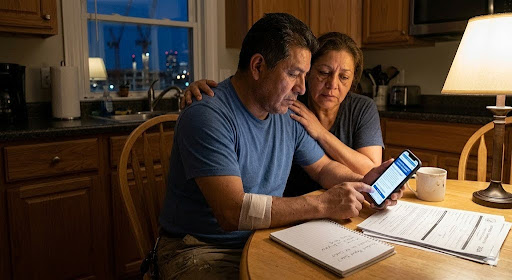
It’s 11:47 PM and someone is typing into a search bar on their phone. Maybe it’s you. Maybe it’s your daughter, searching on behalf of her father who came home from the hospital three hours ago with a fractured vertebra and a foreman’s business card pressed into his palm. The foreman said, “We’ll take care of it. Don’t worry about anything tonight.”
That sentence is exactly when you should start paying attention.
I’ve spent years in workers’ compensation case management and now work alongside plaintiff-side attorneys helping injured construction workers understand what’s actually happening to their claim in the hours and days after an accident. What I see, over and over, is that the most damaging decisions aren’t made in courtrooms. They’re made in hospital waiting rooms, in text messages to supervisors, and in verbal agreements that nobody writes down.
If you’re reading this after a fall, an equipment failure, or a partial collapse on a boston construction accident lawyers job site, here’s what I want you to know before anything else: you are not gaming the system by protecting yourself. You are doing exactly what the system was designed for.
What Happens When You Don’t Act Fast Enough
Picture two workers. Same job site, same type of scaffolding collapse, similar injuries.
Marcus reported the incident to his foreman that afternoon, went to the ER, and assumed his employer would handle the paperwork. He trusted the verbal assurance. He didn’t ask for a copy of the incident report. He gave a recorded statement to the insurance provider the next morning while still on pain medication.
Diane did something different. She asked for a written copy of the incident report before leaving the site. She called her own doctor rather than only the employer-directed clinic. She didn’t give a recorded statement until she’d spoken with an attorney.
Six months later, Marcus’s claim had been partially disputed. The insurer’s recorded statement—taken while he was still in shock—contained language that minimized the fall’s severity. Diane’s claim moved forward with documentation intact.
| Factor | Marcus | Diane |
|---|---|---|
| Incident report | Didn’t request a copy | Requested copy before leaving site |
| Medical provider | Employer-directed clinic only | Chose her own doctor |
| Recorded statement | Gave one while medicated | Waited until consulting an attorney |
| Claim outcome | Partially disputed | Moved forward intact |
The difference wasn’t luck. It was sequence. And sequence is everything after a construction site injury.
The Timeline That Actually Protects You
The first 72 hours are when the most consequential decisions happen. Most injured workers don’t realize it until it’s too late.
Day of the injury: Report the accident to your employer in writing, even if it’s a text message you screenshot. Verbal reports disappear. Written ones don’t. Ask specifically for a copy of the incident report—this is the foundational document that establishes what happened, where, and when. If you’re hospitalized and can’t do this yourself, a family member can request it.
Within 24–48 hours: Seek medical treatment and make sure your records accurately describe how the injury happened. “Patient fell from scaffolding at work site” is very different from “patient fell.” That specificity matters enormously when claim forms are reviewed later.
Within the first week: File your workers’ compensation claim. Don’t wait for your employer to do it for you. In many states, claim filing deadlines are strict—Virginia, for example, requires filing within two years of the accident date, but waiting even weeks can allow the insurance provider to shape the narrative before you’ve had a chance to establish yours.
Before speaking to the insurer: The insurance provider’s adjuster is not your advocate. They may be polite, even sympathetic. Their job is to manage the cost of your claim. A recorded statement given too early—before you fully understand your injuries or your rights—can be used to limit your benefits.
One thing I tell families searching on behalf of someone sedated or in pain: you can ask for time. Saying “we need a few days before providing any statement” is not obstruction. It’s a reasonable request, and any reputable process will accommodate it.
Workers’ Compensation vs. a Third-Party Injury Claim
This is where most people get confused—and where the confusion costs them.
| Workers’ Compensation | Third-Party Injury Claim | |
|---|---|---|
| Fault required? | No | Yes |
| Who pays? | Employer’s insurer | Negligent third party |
| Covers pain & suffering? | No | Yes |
| Recovery cap? | Yes | No fixed cap |
| Can you file both? | Yes | Yes |
Workers’ compensation is a no-fault system. You don’t have to prove your employer was negligent—only that you were injured at work. In exchange for that lower bar, workers’ comp covers medical expenses and a portion of lost wages, but it doesn’t cover pain and suffering, and it caps what you can recover.
A third-party injury claim operates entirely differently. If your injury was caused—or made worse—by someone other than your direct employer, you may have a separate civil claim. On construction sites, this comes up more than people realize: a subcontractor’s equipment failure, a property owner’s unsafe conditions, a crane manufacturer’s defective part. These are third parties, and a personal injury claim against them lives outside the workers’ comp system entirely.
You can pursue both simultaneously. Many injured construction workers don’t know this.
Ohio’s FROI process allows workers to file a First Report of Injury online, by mail, or by fax—giving you options even if you’re not physically able to appear somewhere in person. Most states have similar mechanisms, though the forms and deadlines differ.
The practical question to ask yourself: Was anyone other than my direct employer responsible for the conditions that caused this? If the answer is possibly yes, that’s a conversation worth having with an attorney before you sign anything.
The Step-by-Step Filing Roadmap
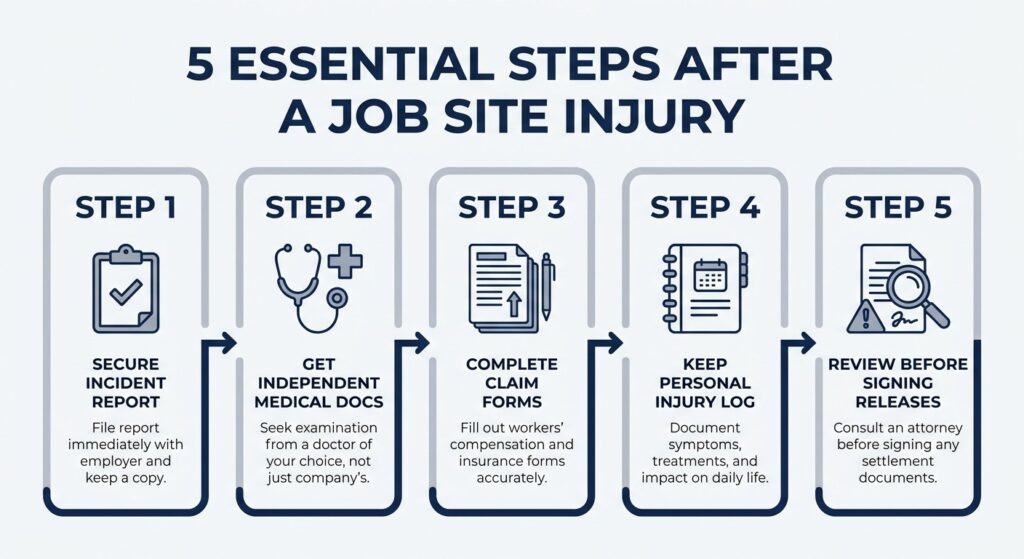
Here’s what the actual process looks like, stripped of the jargon.
Step 1 — Secure the incident report. Not optional. This is the construction site’s official record of what happened. If your employer delays producing it, document that delay in writing. If information in it is inaccurate, note the discrepancies immediately—don’t wait.
Step 2 — Get independent medical documentation. Your employer may direct you to a specific clinic or physician. In many states, you have the right to choose your own doctor after initial treatment. Use it. Make sure every provider documents the mechanism of injury—how it happened, not just what hurts.
Step 3 — Complete claim forms accurately and completely. Workers’ comp claim forms ask specific questions about the accident, your employment status, and your injuries. Vague answers create gaps the insurance provider can exploit. If you’re unsure how to answer something, that’s a legitimate reason to consult an attorney before submitting.
Step 4 — Keep a personal injury log. Starting the day after the accident, write down your symptoms, your limitations, your pain levels, and every interaction with your employer or the insurance provider. Dates, names, what was said. This log becomes evidence if your claim is disputed.
Step 5 — Do not sign medical releases or settlement documents without review. A broad medical release can give the insurer access to your entire medical history—not just the injury in question. A quick settlement offer made in the first weeks is almost always lower than what you’re entitled to.
When Things Go Wrong
“I already gave a recorded statement.” This happens constantly. If the statement contained inaccurate or incomplete information—especially if you were medicated or in shock—document that context now. An attorney can sometimes work to contextualize or challenge a premature statement, but only if you act quickly.
“My employer says I don’t qualify because I’m a subcontractor.” Employment classification is one of the most contested issues in construction injury claims. Many workers labeled as “independent contractors” are legally employees for workers’ comp purposes. Don’t accept that determination at face value.
“The insurance provider denied my claim.” A denial is not the end. You have the right to appeal. The Virginia Workers’ Compensation Commission advises that if a claim is denied, injured workers should request a formal hearing in writing and arrive with all documents, medical reports, and witnesses—because unlike some legal proceedings, there’s typically no opportunity to add new evidence on appeal.
“I’m afraid of retaliation.” Retaliation for filing a workers’ compensation claim is illegal in every state. That doesn’t mean it never happens—it does—but it means you have legal recourse if it does. Document any changes in your hours, assignments, or treatment after filing.
“My boss told me to wait and see how I feel.” Waiting costs you. Symptoms that seem manageable in week one can become chronic conditions affecting your ability to work for years. The claim timeline doesn’t pause while you wait—but your window to document the injury accurately does narrow.
Quick Answers to the Questions I Hear Most
Does filing workers’ comp mean I’m suing my employer? No. Workers’ compensation is an insurance system your employer pays into specifically for this purpose. Filing a claim is not litigation. It’s using a benefit that exists because of your labor.
What if I don’t have documentation of anything yet? Start now. Write down everything you remember about the accident—date, time, location on the site, what you were doing, what failed, who was nearby. Memory degrades fast after trauma, and a written account created soon after the event carries more weight than one reconstructed months later.
Where to Start Right Now
Your first call should be to a workers’ compensation or construction injury attorney for a free consultation—not because you’re filing a lawsuit, but because you need someone in your corner before the insurance provider finishes building theirs.
Gather what you have: written communications with your employer, the incident report if you have it, your medical records, and notes about what happened. Most plaintiff-side attorneys work on contingency, meaning you pay nothing unless they recover something for you. The path forward becomes clearer once someone who understands these claims is looking at the same information you are.