
A Good Lawyer Will Tell You When You Don’t Have a Case
The call I still think about came in on a Tuesday afternoon. A woman had slipped on a wet floor at a grocery store three weeks earlier, hurt her shoulder, missed four days of work. She’d spent those three weeks convincing herself the injury wasn’t serious enough to bother anyone about—and then convincing herself it might be, and then talking herself back out of it. By the time she called us, she was apologizing before she’d even told me what happened. “I don’t want to waste your time if this is nothing.”
That phrase—I don’t want to waste your time—was the most common thing I heard during my years managing intake for a personal injury firm.
People called already braced for rejection. They’d built up this image of lawyers as gatekeepers who would size them up, decide they weren’t worth the effort, and send them away feeling foolish. What most of them didn’t know was that the consultation itself was designed to answer exactly that question. Not to sell them on a lawsuit. To tell them, honestly, where they stood.
That’s what I want to explain here.
Before and After: What Changes When You Actually Know
Think about where you are right now. Something happened—a car accident, a fall, a workplace injury—and you’ve been living in a kind of mental fog since. You’re not sure if what you experienced counts as a legal matter. You’re not sure if calling a lawyer means you’re committing to something. You’re probably Googling at odd hours, reading things that are either too vague or too aggressive, and feeling more confused than when you started.
Now imagine leaving a one-hour conversation with a clear answer.
Maybe the attorney tells you the case has real merit and explains why. Maybe they tell you the facts work against you and here’s the reason. Either way, the fog lifts. You know something concrete. That’s the actual value of a free consultation—not a sales pitch, not a commitment, just information you didn’t have before.
The woman who called apologizing? The attorney told her the case had complications—the store had a wet floor sign partially visible—but that her documented injury and missed wages still gave her standing to pursue a claim. She didn’t have to decide that day. She left knowing her situation clearly, which is exactly what the process is supposed to deliver.
What “Free Consultation” Actually Means (and What It Doesn’t)
This is where a lot of people get tripped up by the marketing.
They see “free consultation” and assume there’s a catch—that free means a quick screening call designed to funnel them into signing a retainer. Some firms do operate that way. But a legitimate consultation is something different.
| What a Real Consultation IS | What It Is NOT |
|---|---|
| A no-obligation meeting to evaluate your claim | A binding agreement to pursue litigation |
| Confidential under attorney-client privilege | A guarantee of representation |
| A professional opinion on case viability | A promise of any specific outcome |
| Your chance to ask direct questions | A sales pitch designed to close you |
Multiple firm guides confirm that a free personal injury consultation is a no-obligation initial meeting where the client discusses a potential claim and the attorney evaluates whether the firm can actually help. No upfront financial commitment. No pressure to decide on the spot.
There’s also a confidentiality piece that matters more than people realize. What you share during that meeting is protected. As one firm’s case evaluation policy makes explicit, the initial evaluation is free and confidential—meaning you can speak honestly about the facts, including the messy or unflattering ones, without worrying that information will be used against you. Attorney-client privilege applies from the moment that conversation begins.
A good personal injury attorney will be direct with you if they don’t think the case is viable. That directness isn’t rejection—it’s the service. The honest “this isn’t a strong case” is more valuable than a firm that takes every case hoping something shakes out.
If you’re in the Boston area and want a sense of what a straightforward, no-pressure intake conversation looks like, a personal injury law firm boston that prioritizes honest case assessment over volume is worth seeking out. The difference in approach is usually apparent within the first few minutes.
What Actually Happens During the Meeting
People imagine consultations as formal and intimidating. In practice, they’re closer to a structured conversation.
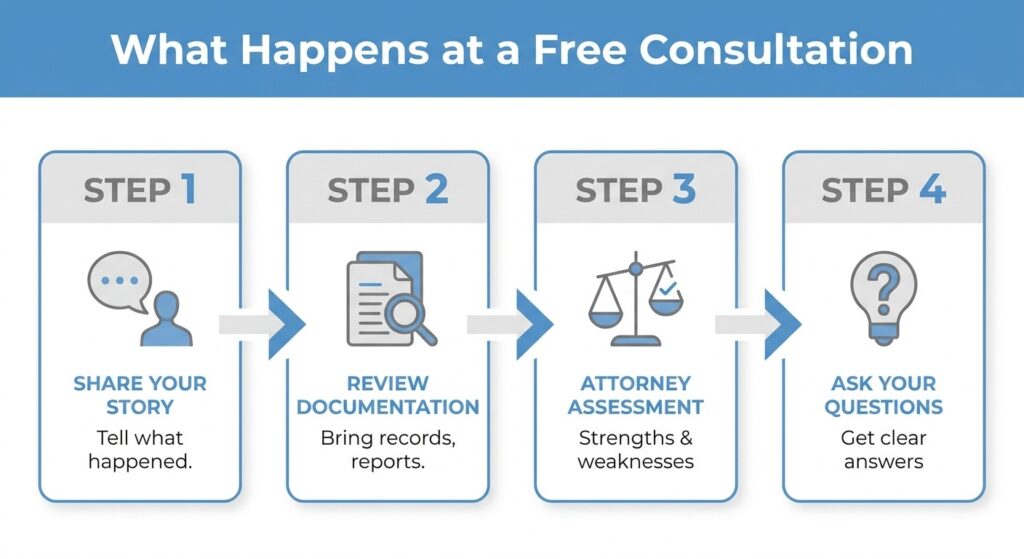
Step 1: You tell your story. The attorney or a senior intake professional starts by asking you to walk through what happened—in your own words, without interruption. This isn’t a deposition. They’re listening for the basic elements that determine whether a legal claim can exist: Was there a duty of care? Was it breached? Did that breach cause your injury? Did the injury result in documented harm? Those four questions are the foundation of every personal injury case, and the attorney is mentally checking them as you talk.
Step 2: They review your documentation. This is where preparation pays off. Firm intake guides consistently recommend bringing accident reports, police investigation notes, citations or tickets issued at the scene, doctor’s notes, and imaging results like X-rays or MRIs, along with your insurance information. The more complete your picture, the more specific the attorney’s assessment can be. Vague facts produce vague answers.
Step 3: You get a preliminary read. After reviewing what you’ve brought, the attorney will share their honest assessment—strengths, weaknesses, and what additional evidence might change the picture. They won’t promise you a settlement number. Anyone who does in a first meeting is telling you what you want to hear, not what’s true.
Step 4: You ask your own questions. What’s the likely timeline? What would the process look like? What are the realistic outcomes? A good attorney answers these plainly. If you leave a consultation more confused than when you arrived, that’s information too.
The Questions People Are Afraid to Ask
What if my case isn’t strong?
Then a good attorney will tell you. This is the part that surprises people most—lawyers turn down cases regularly, and for legitimate reasons. If liability is unclear, if the injuries are minor relative to the costs of litigation, if the statute of limitations has passed, or if the facts simply don’t support a viable claim, an honest attorney says so. That’s not a door slamming in your face. It’s a professional giving you accurate information so you don’t spend months pursuing something unlikely to succeed.
What if I was partially at fault?
This comes up constantly, and it’s one of the most important questions to ask directly. Most states use some form of comparative negligence, meaning your partial fault reduces your recovery but doesn’t automatically eliminate it. Don’t assume partial fault means no case—ask.
What if I already talked to the insurance company?
Tell the attorney exactly what you said. All of it. This is where confidentiality matters—you need to be completely honest about prior statements, even if you said something you now regret. The attorney can only help you navigate the situation accurately if they know the full picture. Surprises hurt cases. Honesty in the consultation room helps them.
Understanding the Contingency Fee Before You Sign Anything
Most personal injury attorneys work on a contingency fee basis. You pay nothing upfront. If there’s no recovery, there’s no attorney fee.
The structure typically looks like this:
- The percentage: Usually between 25% and 40%, depending on complexity and whether the case goes to trial
- Case expenses: Filing fees, expert witnesses, and medical record retrieval may be deducted before or after the percentage is calculated—ask which
- Settlement disagreements: Understand what happens if you want to settle against the attorney’s advice
This structure matters for two reasons. First, it removes the financial barrier that would otherwise prevent most injured people from accessing legal representation. Second, it aligns the attorney’s incentive with yours—they only get paid if you do.
Detailed pre-consultation guidance consistently emphasizes bringing medical bills and insurance correspondence specifically so the attorney can form a clearer picture of potential damages—which directly affects how the contingency math works in your situation. The more documented your losses, the more grounded the conversation about potential recovery.
A reputable firm will walk through the fee agreement line by line. If they rush you past it or get vague when you ask, slow down.
Two Objections Worth Naming Directly
“I don’t want to seem greedy.”
You were hurt because of someone else’s negligence. Seeking compensation for documented medical costs, lost income, and genuine suffering isn’t greed—it’s what the civil system exists for. The discomfort around this is real, but it shouldn’t be the reason you don’t get accurate information about your options.
“I’m not the lawsuit type.”
Most personal injury cases never go to trial. The majority resolve through negotiation. A consultation doesn’t commit you to a courtroom—it commits you to knowing where you stand, which you can then use to make whatever decision fits your situation, including deciding to do nothing.
Before You Call: A Simple Checklist
Gather what you have. Then call.
- Accident report or incident documentation
- Photos from the scene (if available)
- Medical records, bills, or doctor’s notes
- Insurance correspondence
- Witness contact information
- A written summary of key facts: date, location, what happened, what you’ve spent, what you’ve missed
Write down the facts while they’re clear. You’re not committing to anything by making that call. You’re getting information you deserve to have.
It’s okay to ask. And it’s okay if the answer isn’t what you hoped for. An honest answer—whatever it is—puts you in a better position than the fog you’re in right now.